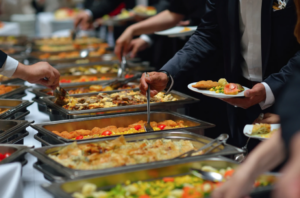
Food is inherently social, involving people in every stage—including how it is produced, processed, distributed, consumed, and disposed of, and who is involved at every step. Because of this, shifting agriculture, fisheries and food systems toward sustainability and equity requires a deeper understanding of history, values, inequalities, and relationships.
Building a bigger table: Strengthening our relations will bring four key food networks–the Common Ground Network, Food Secure Canada, the Canadian Association for Food Studies, and Food Communities Network–together in a forum focused on understanding the social relations necessary for transitioning and transforming Canada’s agriculture, fisheries and food systems to be equitable and sustainable.
Specifically, building a bigger table will bring academic researchers together with agriculture and food systems actors, including civic/community organizations, government, industry organizations, and Indigenous and settler communities, to share knowledge, forge and strengthen connections across disciplines and sectors, and seed new collaborations in food systems research and action.
The Forum will feature individual paper presentations, organized panels, roundtables, plenaries, keynote speakers, workshops, poster sessions, and an Exploration Gallery, all organized around four ‘pillars’ of social relations that underpin the Common Ground Network’s work.
These include relations between:
- People and Land
- Rural and Urban communities
- Canada and the World
- People in/and Food Systems.
We are particularly interested in supporting content that:
- Moves us towards knowledge sharing
- Builds social expertise around sustainable agriculture, fisheries and food systems
- Strengthens connections amongst researchers and affected groups
- Develops shared goals and objectives.
We encourage submissions of any of the above formats on critical and theoretical work, community-based and on-the-ground practice, research-creation and transdisciplinary initiatives, and creative, thought- and feeling-provoking investigations.
Within the broad theme of Building a bigger table: Strengthening our relations, submissions may include, but are not limited to:
- Next-generation scholarship
- Food policy and advocacy
- Food sovereignty
- Food affordability and food insecurity in Canada
- Corporate concentration in the food system
- Food systems and equity
- Global food systems and regimes
- Indigenous food systems and rights relations
- Climate change
- Labour and exploitation
- Racism and anti-racism
- Food epistemology
- Food pedagogy
- Media and communications
- Arts, culture, literature
- Hybrid practice & transdisciplinary approaches to food
- Cross-sector collaboration
- Process design and speculation
In addition to content-based submissions, we also welcome contributions for reimagining the processes by which the Forum’s members and their larger communities interact. The submission form includes an option to propose ways to build a larger table into the forum infrastructure itself.
VOICES
In our efforts to move towards a more equitable, decolonized environment, we will be giving contributor preference to people who choose to identify as being from marginalized, historically oppressed groups of people (for example: Black, Indigenous, and People of Colour, 2SLGBTQIA+, newcomers, people living with disabilities, Francophones, low-income people).
In addition, many other groups have also been historically excluded from academic, leadership and policy spaces, including activists, producers, youth/students and community practitioners.
To ensure these groups are prioritized in the forum program, people can self-identify on the submission form.
As part of all our contributions, we ask everyone to take time to share this with diverse populations.